
In Bali, every step you take may bring you face to face with a tiny, colorful offering placed on the ground, outside homes, on sidewalks, in front of shops, or on motorbikes. These small, square-shaped arrangements of flowers, leaves, and incense are called canang sari. More than a simple religious gesture, they are a central part of Balinese daily life. Each one carries a quiet prayer, a sense of gratitude, and a connection to the divine. Their presence is so constant that they become invisible to some, yet they hold a profound symbolic, spiritual, and artistic meaning.
A ritual that shapes the everyday
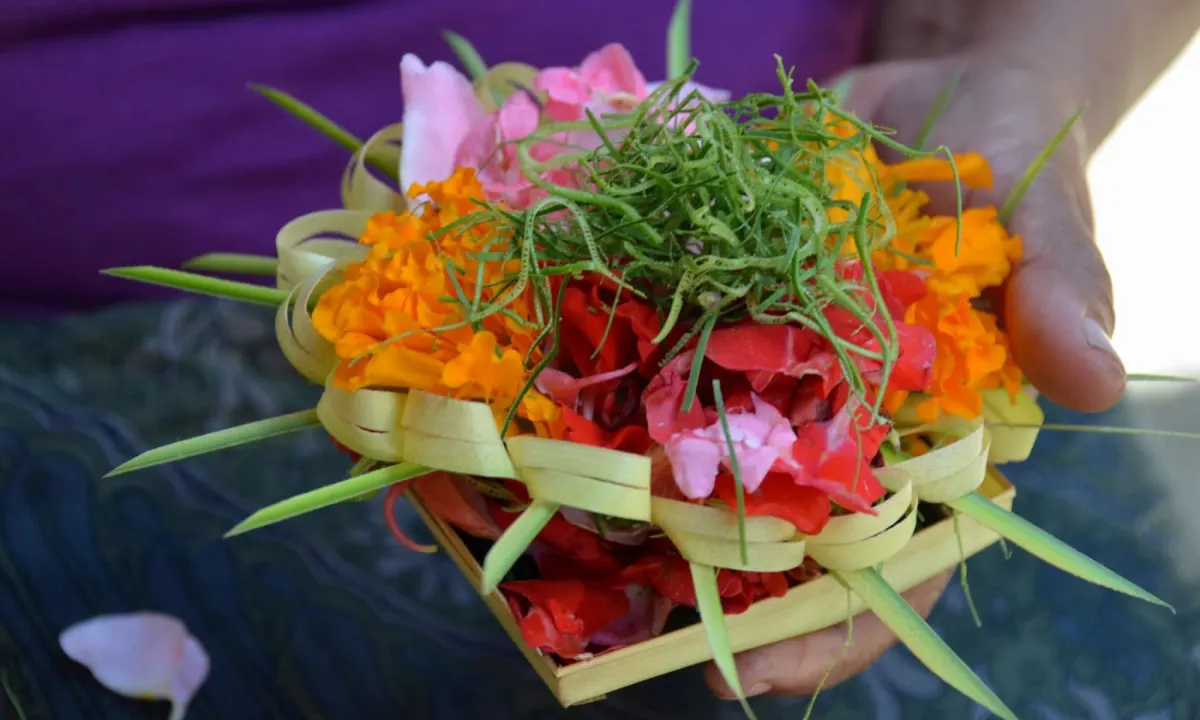
Every morning, often before sunrise, Balinese women begin preparing canang sari. It is part of the rhythm of daily life. The materials are simple: coconut leaves woven into a shallow tray, bright petals arranged carefully, a pinch of rice, sometimes a candy, cigarette, or coin, and a stick of incense that burns and sends a thin trail of smoke skyward. But the meaning behind these offerings is anything but simple.
The purpose of the canang sari is not to ask the gods for favors. It is not a request, but a thank you. It is an expression of gratitude to the divine and an acknowledgment of the balance between good and evil, light and dark, joy and suffering. This balance is central to the Balinese philosophy of Tri Hita Karana, which teaches harmony between people, nature, and the gods. By offering canang sari, Balinese people reinforce this balance, creating a connection between the physical and spiritual worlds.
Layers of symbolism and sacred geography
Though small and made with natural materials, the canang sari follows a deep symbolic structure. The name itself holds meaning: “canang” refers to the small palm leaf tray, and “sari” means essence. It is the essence of an offering, a small but meaningful gesture directed to the gods.
The arrangement of the flowers within the tray is not random. Each petal color and placement corresponds to a cardinal direction and a specific deity. White petals are placed facing east to honor Iswara. Red petals face south for Brahma. Yellow petals face west for Mahadeva. Blue or green petals go north for Vishnu. The center may contain a multicolored flower or symbolic item to represent Shiva. In this way, every canang sari becomes a miniature sacred map, placing the divine presence in all directions.
Some canang sari include symbols of daily life: a piece of food, a coin. These are not casual additions but personalized touches. For example, if someone is praying for harmony in their workplace, they may include something from their office. Each object is chosen with care and intention.
Women as guardians of the tradition
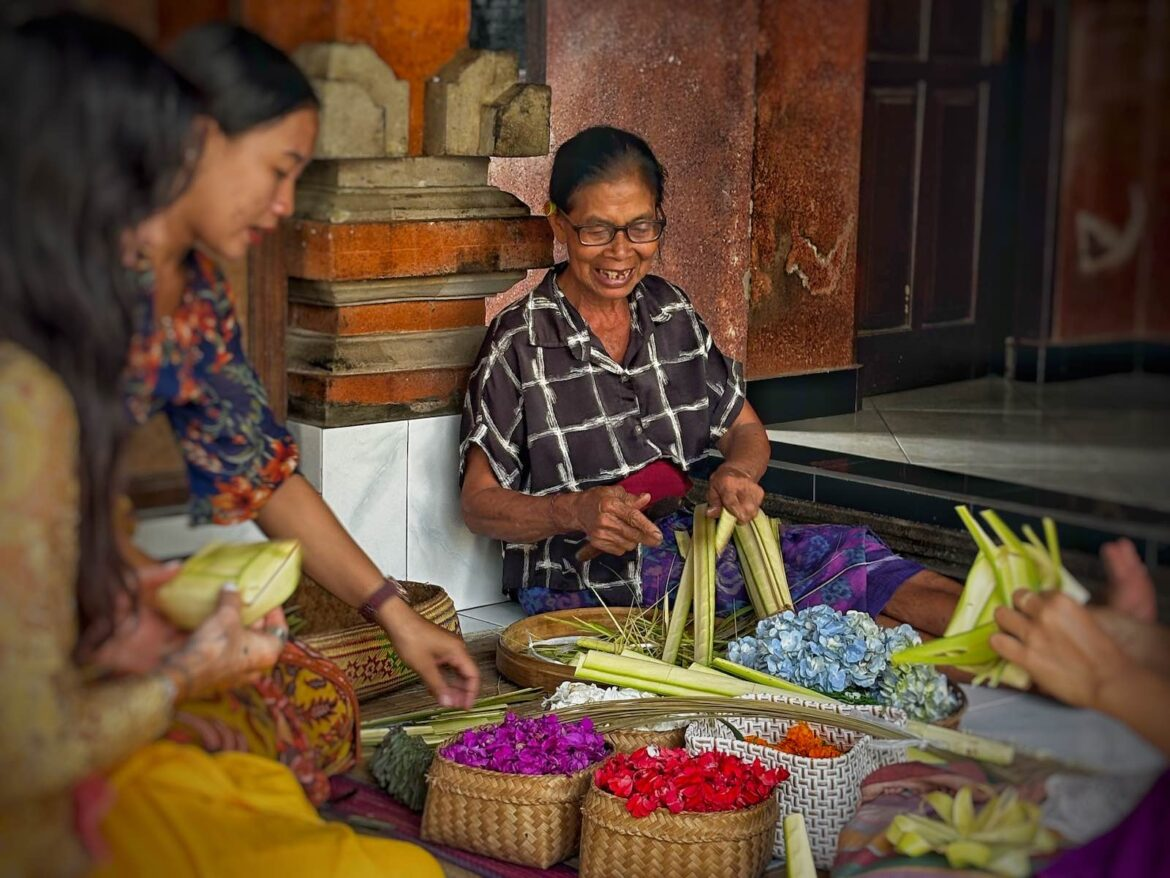
The daily creation of canang sari is most often the responsibility of Balinese women. From a young age, girls learn how to fold and weave coconut leaves, how to pick and arrange flowers, and how to perform the ritual of placing the offering. This transmission is done orally, by watching and doing, usually within the family home.
Despite modern life and growing tourism, this tradition continues. Even women who work full-time often wake up early to prepare and place offerings before starting their day. It is not seen as a burden but as a sacred duty, an act of quiet discipline, love, and connection. The simple motion of placing an offering, bowing the head, and lighting the incense becomes a form of meditation. A moment of pause in a fast-moving world.
A delicate balance between beauty and faith
One of the most striking aspects of canang sari is their visual beauty. Though they are made from everyday materials, they are arranged with care and often with an eye for color, symmetry, and detail. Some women add a creative touch, folding the leaves into elegant shapes, arranging flowers in intricate patterns, or using unusual elements to express a personal intention.
There is no “right” or “wrong” way to make an offering, as long as it is done with sincerity. Still, the aesthetic dimension is always present. This attention to beauty reflects a larger truth in Balinese culture: that the sacred and the artistic are not separate. To create something beautiful is, in itself, an offering.
During major religious festivals like Galungan or Kuningan, larger and more elaborate offerings are created. These can include fruits, cakes, textiles, and even sculpted decorations. Carried in processions and displayed in temples, they are true works of art, but their spiritual meaning remains the same.
An art that disappears by design
One of the most moving aspects of canang sari is their impermanence. Within hours of being placed, they are stepped on, blown away by the wind, or eaten by dogs or birds. The incense burns down. The petals wilt. By the afternoon, little remains.
Yet this does not lessen their value. The canang sari is not meant to last. Its power lies in the act of giving, not in its permanence. It is a reminder that devotion can be expressed in fleeting ways, that beauty and intention do not require longevity. In this sense, the offering becomes similar to performance art ephemeral but meaningful, grounded in presence and sincerity.
Transforming space into sacred ground
The presence of canang sari throughout the island transforms the landscape of Bali. Every corner of the public space becomes a site of spiritual significance. The entry of a shop is a place to honor prosperity. The dashboard of a taxi becomes a temporary altar. Even the threshold of a restaurant may be blessed with several offerings in a day.
This sacred mapping of space is deeply Balinese. It reminds everyone, locals and visitors, that the world is full of unseen energies. It creates a kind of collective awareness, a consciousness of the divine in the everyday.
Tourists are often surprised by the sheer number of offerings and their placement directly underfoot. Many learn quickly to step around them respectfully. Some are curious and ask to participate. Hotels sometimes offer canang sari workshops, not just as a tourist activity but as a way to foster cultural understanding.
A symbol of Balinese identity
At its heart, canang sari represents the Balinese way of life. It brings together spirituality, artistry, ritual, discipline, and community. It is a practice that happens at the scale of the individual and of the entire society. It is humble but profound.
In a world increasingly shaped by technology, speed, and convenience, canang sari offers a very different model. It reminds us that devotion can be simple, that beauty can come from nature, and that peace can be cultivated through repetition and care.
This small daily act quiet, fleeting, and beautiful, tells the story of a people who live in deep connection with their gods, their land, and one another. In the canang sari, the invisible becomes visible, the ordinary becomes sacred, and the daily becomes eternal.