
In Bali, death is not seen as a tragedy but as a transition. It marks the start of a new journey for the soul. The cremation ceremony known as Ngaben is one of the most important and spiritual rituals in Balinese Hindu culture. It is not quiet, not black, not hidden. It is colorful, collective, and full of life.
For those who witness it for the first time, Ngaben can be deeply moving, even overwhelming. It is an event where faith, art, tradition, and community come together to honor both the dead and the cycle of life.
Helping the soul move on
Balinese Hindus believe that the soul, called atma, continues after death. But to move on, either to be reincarnated in a new body or to reach a spiritual realm, it must be freed from the physical body. Ngaben allows that release.
Fire is the element that transforms. It purifies the body and guides the soul upward, away from the world of the living. Without this ceremony, the soul is believed to remain trapped, confused, or even capable of disturbing the lives of loved ones. This is why Ngaben is not optional. It is a vital spiritual duty for the family of the deceased.
Ancient roots and cultural identity
Ngaben is not a modern tradition. Its roots go back hundreds of years, influenced by Indian Hinduism but deeply transformed by local Balinese beliefs. Over time, it has evolved into something uniquely Balinese, mixing animism, Hindu cosmology, and community rituals.
The cremation ceremony is not just a religious act but a strong symbol of Balinese identity. Even in a rapidly modernizing Indonesia, Balinese people continue to maintain and defend these spiritual customs as a core part of who they are.
A long and collective preparation
Organizing a Ngaben is never simple. It involves careful planning, community effort, and significant financial cost. Families often need months to prepare, especially if they want to include detailed decorations, sacred objects, music, and traditional dances.
It is common for villages to organize group cremations where several families share the event and the expenses. This reinforces the idea that death is not private, but a shared experience. Everyone in the village plays a part.
Men work together to build massive wooden structures like the cremation tower, or wadah, and the sacred bull called lembu. Women spend days preparing hundreds of offerings using fruits, flowers, and palm leaves. Children are also involved, helping or simply observing to learn the tradition.
Priests guide the process and choose the correct date for the ritual based on the Balinese calendar. The ceremony must follow the proper spiritual timing and structure. Nothing is left to chance.
The day of the ceremony
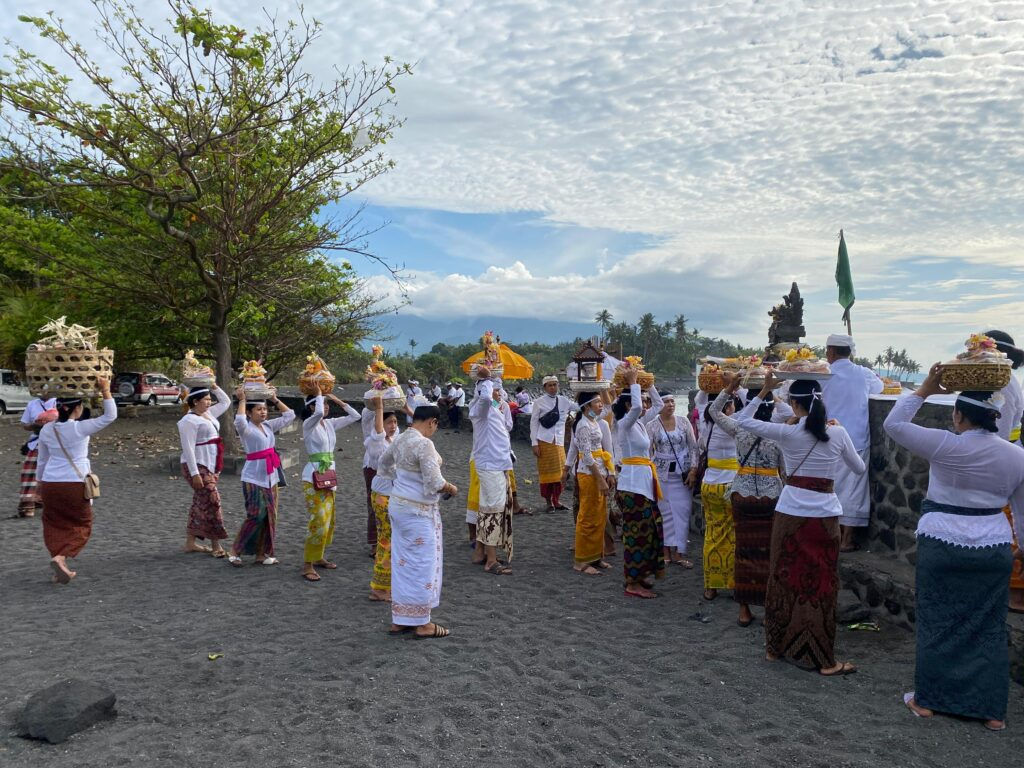
At sunrise, the village begins to stir. People dress in ceremonial white and yellow. The air smells of incense and sandalwood. Gamelan music echoes across the rice fields.
Family members carry offerings wrapped in banana leaves. The cremation tower stands tall and bright, decorated with gold, mirrors, and colorful fabric. It looks almost festive, like a temple or a parade float.
Then comes the procession. The body is placed in the tower and carried through the village. At each intersection, the bearers spin the tower quickly. This action is meant to confuse evil spirits so they cannot follow the soul. Onlookers chant, pray, or throw flower petals as the tower passes.
After reaching the cremation site, the body is transferred into the lembu. The priest gives a final blessing. Fire is lit. The flames rise, crackle, and consume everything: the body, the bull, the tower. People watch in silence. Some cry softly. Others smile. It is a goodbye, but also a release.
After the fire
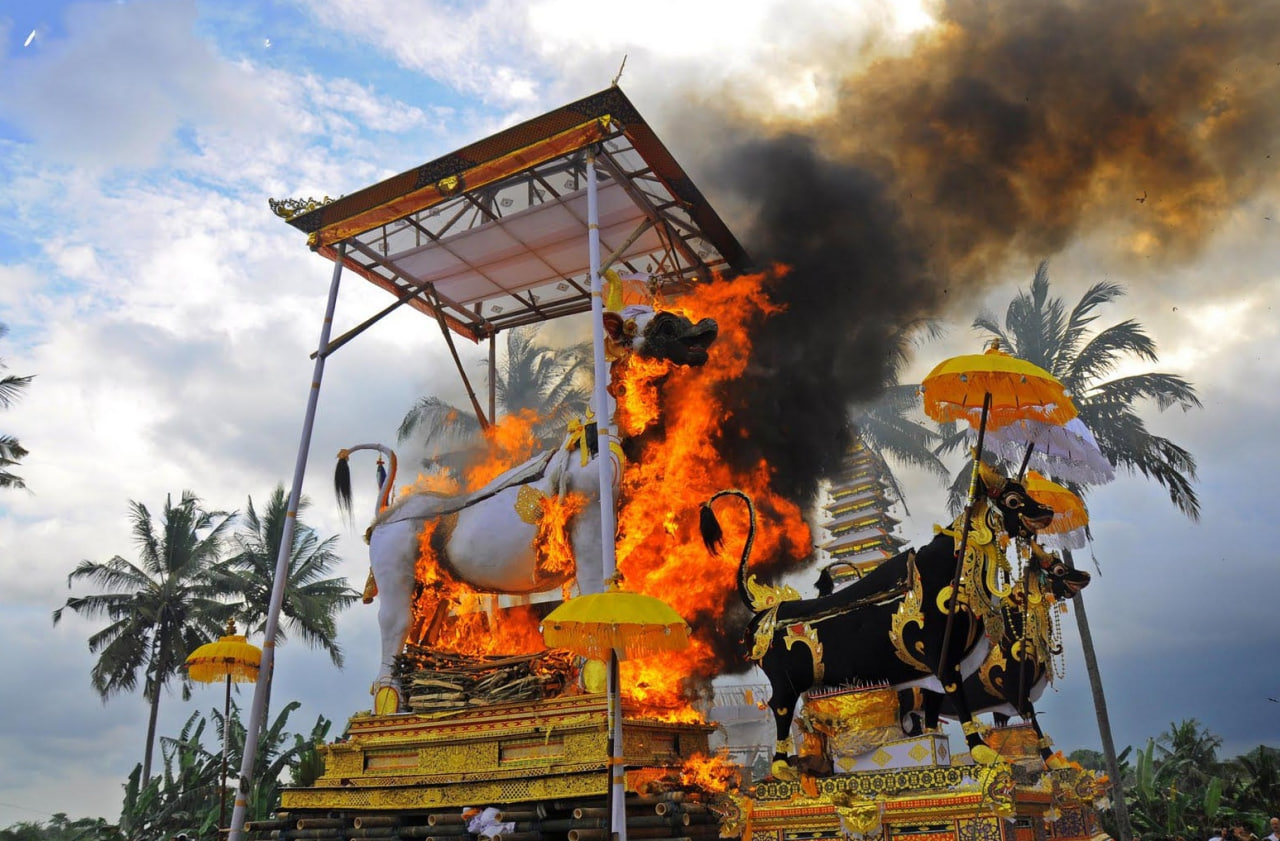
Once the fire has cooled, family members gather the ashes. These are placed in a special container, often made of coconut shell or clay. A few days later, a second ceremony is held.
The ashes are taken to a sacred river or the sea. There, they are released into the water. Water, like fire, is cleansing. This final gesture returns the body to nature and completes the journey.
The role of women
Women play a quiet but powerful role in Ngaben. They prepare most of the offerings, dress the body, and support the spiritual work behind the scenes. In some cases, they lead the songs or help coordinate the process with the priest.
Although Balinese society is still influenced by caste and gender roles, many Ngaben ceremonies are deeply matriarchal in their energy. The patience, emotion, and care given by the women are as essential as the fire itself.
Art made to disappear
One of the most striking things about Ngaben is the beauty of what is built, and the fact that it is all meant to disappear. The bull, the tower, the banners, the flowers, the masks. Everything is temporary. Everything burns.
This is not seen as sad. It is a spiritual message. Life is change. Nothing lasts. Beauty is not in permanence, but in the act of giving and letting go.
Ngaben teaches that destruction can be sacred. That fire can be an offering. That even grief can be transformed into grace.
Foreign eyes on a sacred event
In areas like Ubud, some Ngaben ceremonies are open to the public. Tourists often hear the music, see the colors, and follow the procession from a respectful distance.
Locals are generally welcoming, as long as visitors act respectfully. That means covering shoulders and knees, not touching the structures, not taking photos without permission, and staying silent during the most sacred moments.
Some families may even invite curious visitors to observe, especially if they sense genuine interest and understanding. For many travelers, it becomes a moment they never forget.
A different view of death
Ngaben offers a completely different perspective on death. It shows how a community can honor the dead not through silence, but through ceremony. Not through sadness alone, but through beauty, music, and togetherness.
In Bali, the dead are not left alone. They are carried through their final steps by a village, a family, a fire, a prayer.
For the living, Ngaben is not just a farewell. It is a reminder of life, of love, and of the deep connection between the visible and the invisible world.