
Indonesia is an immense archipelago made up of over 17,000 islands, each with its own unique culture, languages, and traditions. This incredible diversity has made the country one of the most fascinating places in the world for art. For thousands of years, people in Indonesia have used art to express their beliefs, identity, and history. From cave paintings created by prehistoric humans to contemporary artworks exhibited in galleries around the world, Indonesian art has constantly evolved. It has absorbed influences from many different cultures and religions while keeping a strong connection to local traditions.
The beginnings: prehistoric art and spiritual expression
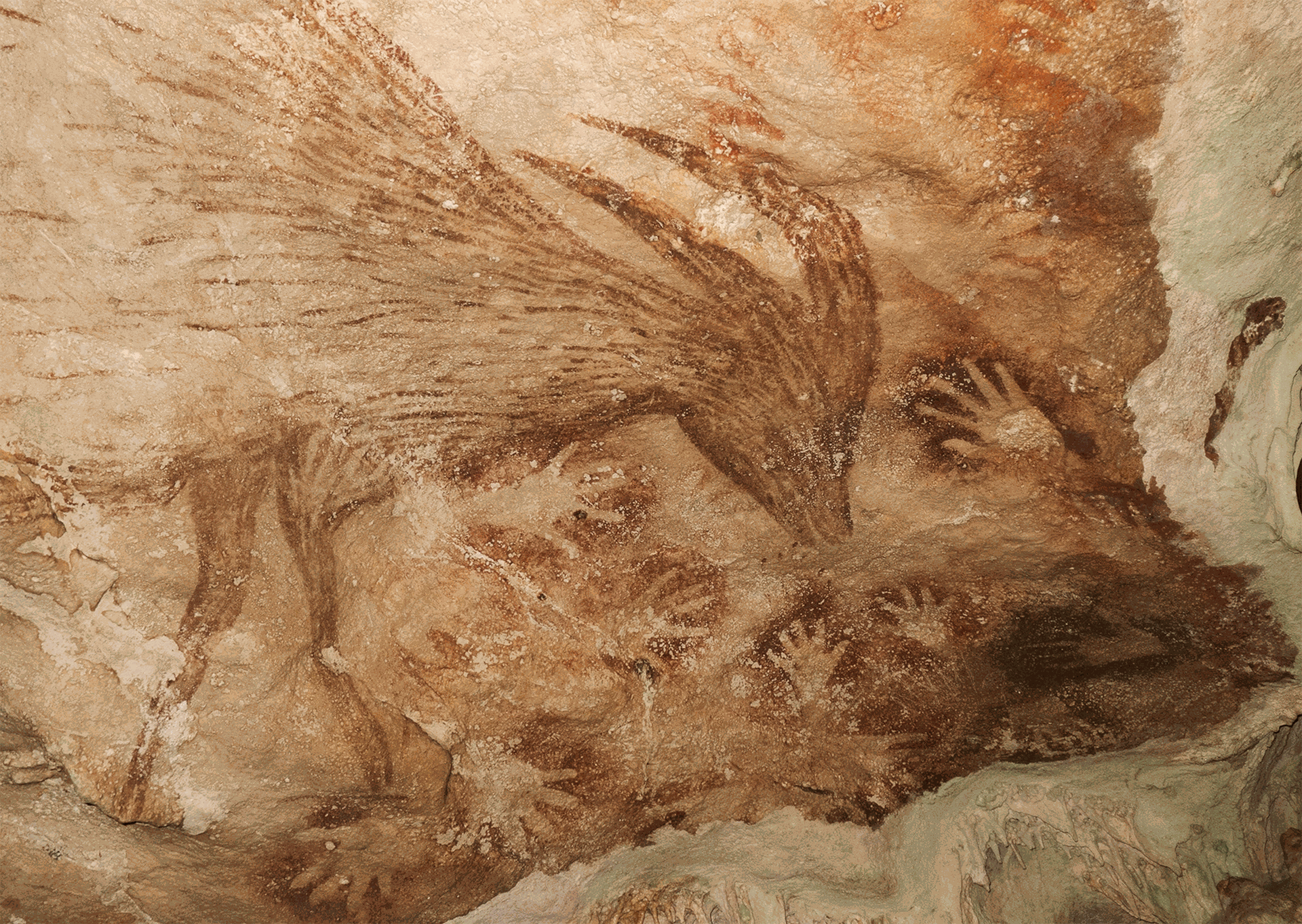
The earliest known artworks in Indonesia date back more than 40,000 years. These ancient paintings can be found in caves on the island of Sulawesi, particularly in the Maros-Pangkep region. In the cave of Leang Timpuseng, archaeologists discovered hand stencils and animal drawings made using red pigment. One of the most famous images is of a babirusa, a wild pig with curved tusks. These artworks are among the oldest in the world and prove that early humans in Indonesia were already capable of symbolic thinking.
These prehistoric artworks were not only decorative. They were probably used for rituals, spiritual purposes, or storytelling. Handprints, for example, may have represented the presence of a person, or acted as a mark of belonging to a group. Animals might have been connected to hunting magic, survival, or mythological beliefs. Although we can never fully know what these early artists intended, their paintings reveal a deep connection between humans, nature, and the unseen world.
Indian influence: The era of hindu and Buddhist art
Around the 7th century, new ideas began to arrive in Indonesia, brought by Indian traders and religious teachers. These included Hinduism and Buddhism, which quickly spread through the islands of Java and Sumatra. Local rulers welcomed these religions, often building impressive temples as symbols of their power and devotion.
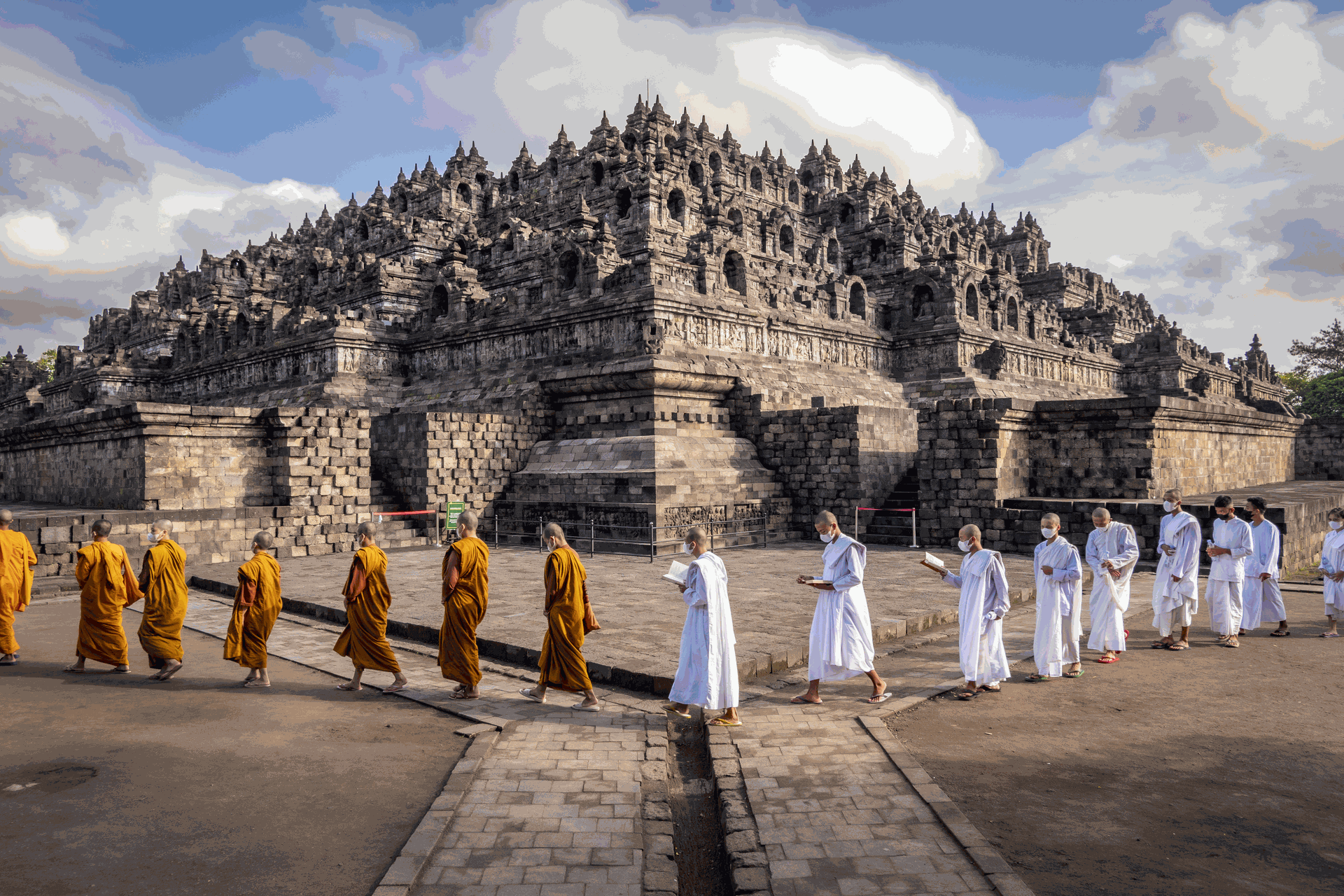
One of the most famous monuments from this period is Borobudur, a massive Buddhist temple built in Central Java in the 9th century. Shaped like a giant mandala, Borobudur is covered in stone carvings and filled with statues of the Buddha in meditation. The carvings tell stories from Buddhist scriptures, guiding visitors on a symbolic journey toward enlightenment as they walk up each level of the structure.
Not far from Borobudur stands Prambanan, a Hindu temple complex built in the same era. Prambanan is dedicated to the gods Shiva, Vishnu, and Brahma. Its tall towers and stone walls are decorated with scenes from the Ramayana, an ancient Indian epic. These temples are not only religious centers, but also masterpieces of architecture and sculpture, showing how Indonesian artists had mastered stone carving, symmetry, and spiritual storytelling.
During this period, art was closely linked to religion and the royal courts. Kings supported artists who could help glorify their rule and bring spiritual protection to the kingdom. Statues, reliefs, and inscriptions were created to honor gods, ancestors, and the cosmos.
The arrival of Islam: A shift in style and symbols
From the 13th century onward, Islam began to spread across Indonesia, especially through trading ports on the coasts of Sumatra, Java, and Sulawesi. Unlike Hindu and Buddhist art, Islamic art tends to avoid images of people or divine beings. Instead, it often uses calligraphy, abstract patterns, and floral designs. This change led to the development of new artistic forms, while many older traditions were reinterpreted in a different way.
One important example of this blend is batik, a traditional technique for dyeing fabric using wax and natural dyes. Although batik existed before Islam, it flourished under Muslim influence, especially in Central Java. Certain patterns were reserved for the royal family, while others had symbolic meanings based on local myths or religious ideas. Even today, batik remains an important part of Indonesian culture, worn at weddings, ceremonies, and official events.
Another example is wayang kulit, the shadow puppet theatre that developed from earlier Hindu traditions. Although the stories still come from the Mahabharata and Ramayana, they were adapted to fit Islamic values and local customs. The dalang, or puppeteer, might replace references to gods with spiritual figures or ethical lessons, and the performance often includes messages about morality, social justice, or human behavior.
Despite the new religious influence, traditional art forms continued to evolve without disappearing. In many areas, especially in Java and Lombok, Islamic art coexisted with local beliefs, creating a unique mixture of aesthetics and meanings.
The colonial period and the rise of modern art
In the 19th century, Indonesia became a colony of the Netherlands, which had a major impact on local culture. Dutch artists and scientists documented the archipelago’s landscapes and people, while Indonesian artists began to learn new techniques from Europe, such as oil painting, perspective, and realism.
One of the most important figures from this period is Raden Saleh, who was born in 1811 in Java. He studied in the Netherlands and became one of the first Indonesians to paint in the European romantic style. His paintings, which include hunting scenes, wild animals, and dramatic landscapes, combined Western techniques with a tropical atmosphere and Indonesian subjects. Raden Saleh is considered a pioneer of modern Indonesian art and an early example of cross-cultural exchange.
In the early 20th century, a new generation of Indonesian artists began to reject colonial styles. They wanted to create a national art that spoke to the realities of their own people. Artists like S. Sudjojono and Affandi used expressive brushstrokes, bold colors, and emotional scenes to reflect daily life, poverty, war, and social change. These artists were part of Indonesia’s struggle for independence and used their work as a form of resistance.
Post-Independence art: new voices and new media
After gaining independence in 1945, Indonesia experienced a cultural renaissance. Artists were now free to explore their own identity and experiment with new ideas. Art schools opened in cities like Yogyakarta and Bandung, offering formal training in painting, sculpture, and design. The government supported exhibitions and cultural festivals to promote national unity.
Throughout the 1960s and 70s, many artists focused on themes like rural life, tradition, and revolution. However, others began to push the boundaries of art, using photography, collage, and installation. By the 1990s, a new wave of contemporary artists emerged who dealt with political issues, globalization, environmental destruction, and urban life.
One notable example is Heri Dono, who combines traditional elements like puppets and masks with modern installations, animations, and performance. His work often criticizes corruption or military power, using humor and absurdity. Another major milestone was the participation of the Indonesian collective ruangrupa in the 2022 edition of Documenta, a prestigious international art exhibition held in Germany. This showed that Indonesian contemporary art was not only active but globally relevant.
Today, Indonesian art includes a wide range of practices, from traditional dance and sculpture to digital art, street murals, and video. Artists often explore the relationship between the modern world and ancient beliefs, between urban stress and natural beauty, between the global and the local.
Conclusion
The history of Indonesian art is a reflection of its people and their journey through time. From the prehistoric caves of Sulawesi to the high-tech galleries of Jakarta and beyond, Indonesian art continues to express deep emotions, spiritual beliefs, and social realities. It adapts, reinvents, and resists, but never forgets its roots.
Through its many transformations, Indonesian art tells the story of a nation shaped by diversity, resilience, and creativity. Whether carved in stone, painted on fabric, or projected through digital screens, it remains a powerful tool to understand the soul of Indonesia.