
Bali, often referred to as the Island of the Gods, is much more than just a tropical getaway with sandy beaches and emerald-green rice terraces. Behind its postcard beauty lies a rich spiritual landscape where temples, rituals, and centuries-old traditions continue to shape every aspect of daily life. The island is a place where sacred history and everyday routines are closely intertwined, where religion is not only practiced in grand ceremonies but also in the quiet gesture of placing a flower offering before breakfast. At the heart of this cultural universe stand the temples, known as pura in Balinese. These structures are not merely religious monuments but living spaces, community centers, and symbols of identity. They are the backbone of Balinese Hinduism, a spiritual tradition that is both ancient and uniquely adapted to the island’s way of life.
A historical legacy rooted in Hinduism
Bali’s religious roots reach back to a time when Indonesia was shaped by powerful kingdoms, international trade, and spiritual migrations. While much of Indonesia embraced Islam by the 15th century, Bali remained a Hindu stronghold. This is largely due to the influence of the Majapahit Empire, a vast Hindu-Buddhist kingdom that ruled much of Java and Bali between the 13th and 15th centuries. When the empire declined, many Javanese priests, nobles, artists, and intellectuals fled to Bali, bringing with them their sacred texts, rituals, and artistic knowledge. This migration would mark the beginning of a profound transformation. The newcomers blended their Indian-inspired Hinduism with the indigenous animist traditions already practiced by the Balinese people. The result was a unique form of Hinduism that emphasizes balance, cycles, and the interconnectedness of all life.
This spiritual worldview is reflected in the architecture of Balinese temples. Unlike many Western religious buildings, a pura is not an enclosed space but a series of open-air courtyards that guide visitors from the outer, public areas to the inner, most sacred zones. The design follows the principles of Tri Hita Karana, a foundational Balinese philosophy that seeks harmony between human beings, nature, and the divine. Everything, from the direction a temple faces to the placement of statues and shrines, is chosen to maintain cosmic balance.
A sacred geography: Bali’s major temples
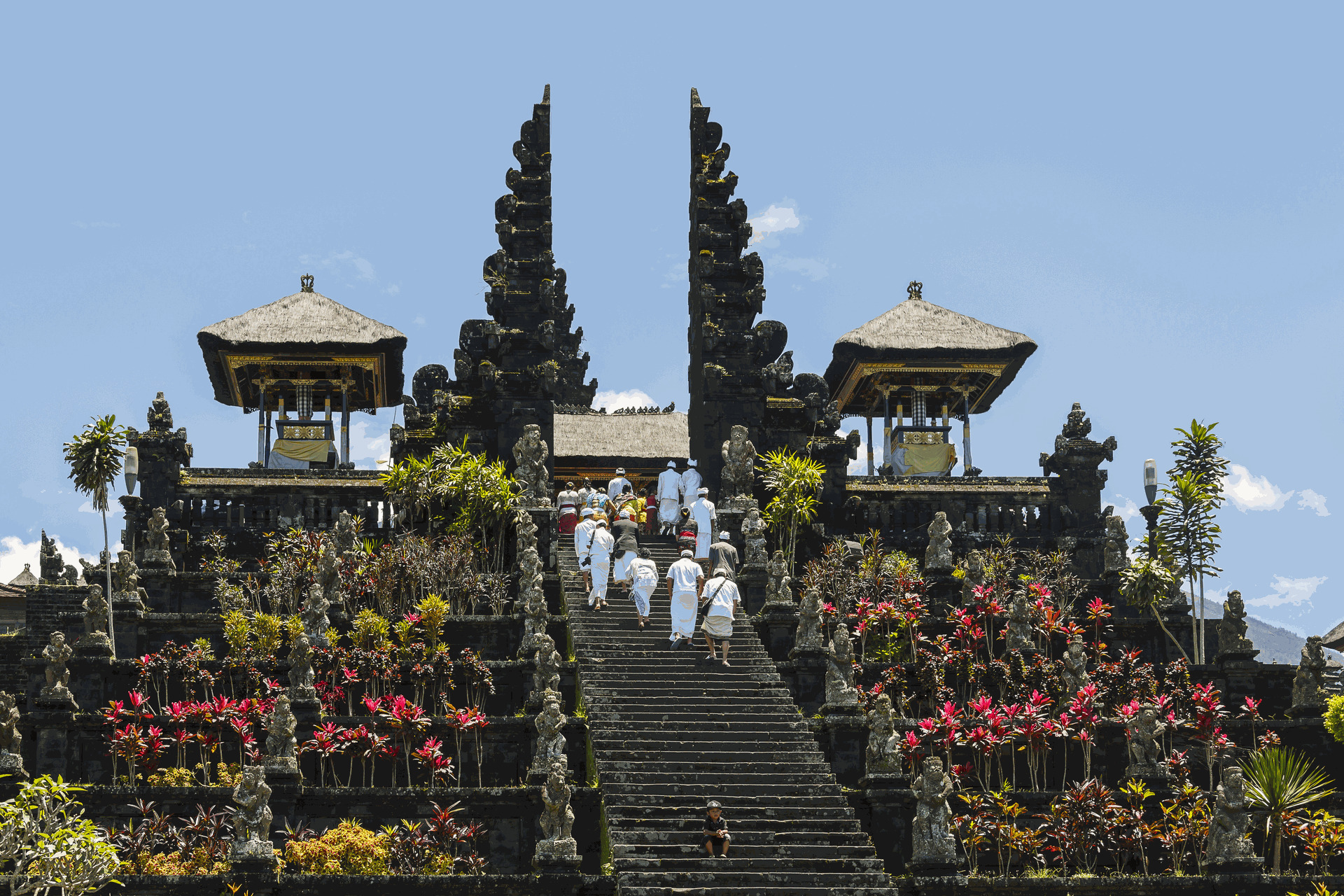
Temples are everywhere in Bali. It is said that there are more temples than houses on the island. Each family has its own shrine, every village has at least three main temples, and entire regions are home to temples considered sacred by all Balinese. Among them, Pura Besakih is perhaps the most revered. Known as the “Mother Temple,” it is located more than 1,000 meters above sea level on the slopes of Mount Agung, Bali’s most sacred volcano. The temple complex includes over eighty separate structures, each dedicated to a different deity or aspect of life. During major religious ceremonies like Bhatara Turun Kabeh, thousands of people from all over Bali climb the mountain to offer prayers and receive blessings, believing that the gods descend to Earth during these sacred times.
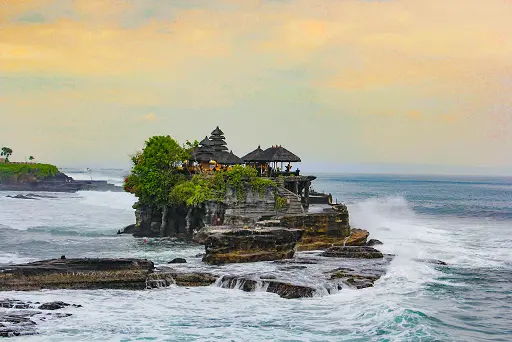
Another iconic temple is Tanah Lot, perched dramatically on a rock formation along the coast of Tabanan. This sea temple is dedicated to the ocean god and is one of the most photographed places in Bali, especially at sunset. But beyond the picture-perfect view lies a deeper legend. According to tradition, Tanah Lot was founded by the Hindu priest Dang Hyang Nirartha in the 16th century. Guided by a spiritual vision, he built the temple as a place to honor the spirits of the sea and protect the island from evil forces.
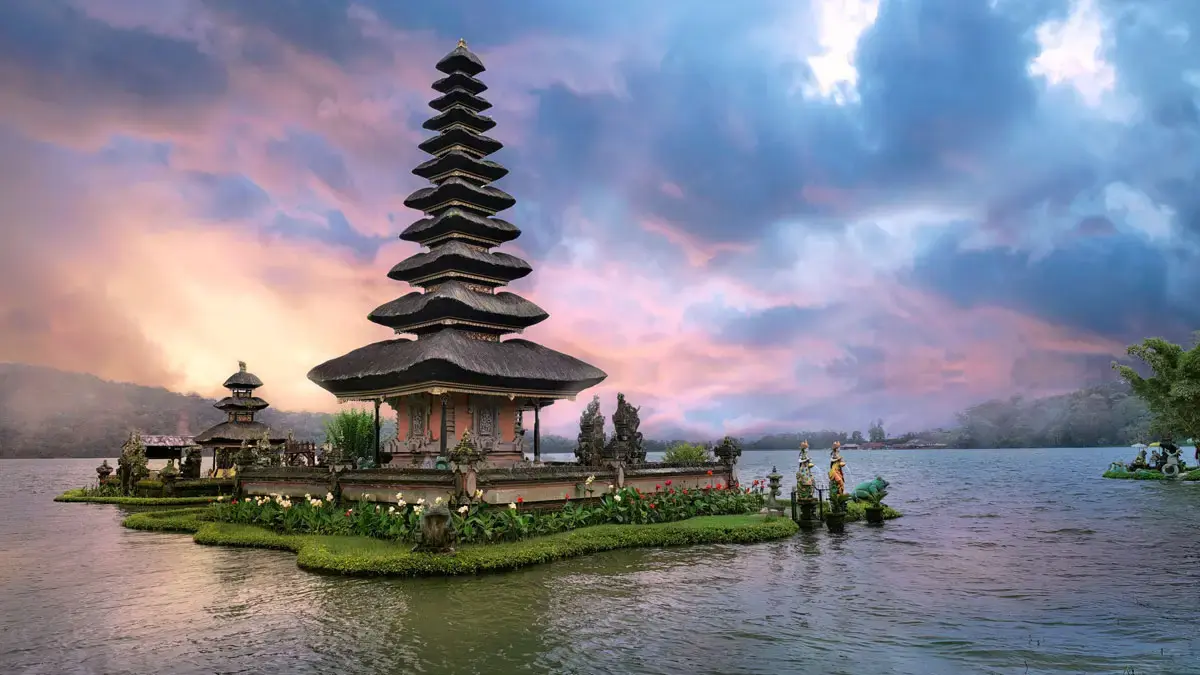
In the central highlands of Bali, where the mist often rolls over green hills and lakes, stands Pura Ulun Danu Beratan. This temple, located on the edge of Lake Beratan, is dedicated to Dewi Danu, the goddess of water and fertility. It plays a crucial role in Bali’s rice cultivation, as the lake feeds the subak system, a centuries-old irrigation network that supports the island’s famous terraced rice fields. The subak is not only an agricultural method but also a spiritual system, recognized by UNESCO as a World Heritage site for its harmonious integration of water, community, and faith.
Living tradition in everyday Balinese life
In Bali, religion is not confined to temples or holidays, it is woven into the fabric of everyday life. Every morning, before the sun rises too high, you can see people placing small offerings called canang sari in front of doorways, on sidewalks, or even on the dashboards of cars and scooters. These offerings, made from palm leaves, flowers, rice, and a stick of incense, are humble but powerful acts of gratitude and prayer. They are created fresh each day and are offered to thank the gods, appease spirits, and maintain balance in the world.
Each temple operates according to a special calendar based on the pawukon, a 210-day cycle that determines sacred days, festivals, and temple anniversaries. One of the most important celebrations in a temple’s life is Odalan, its birthday, which includes several days of processions, music, dance, offerings, and communal feasts. People dress in ceremonial attire, children perform traditional dances, and priests lead long rituals filled with mantras and holy water. The energy during an Odalan is joyful and deeply moving, as the entire community comes together to honor the divine.
Bali’s major religious festivals also reflect this mixture of cosmic belief and daily practice. Among the most significant are Galungan and Kuningan. Galungan celebrates the victory of dharma (good) over adharma (evil), and marks the time when ancestral spirits return to the world of the living. Families prepare elaborate offerings, visit temples, and decorate their homes with penjors, tall bamboo poles adorned with coconut leaves, fruit, and sacred cloth. Ten days later, Kuningan marks the departure of the ancestral spirits back to the spiritual realm. During this time, sacred dances like the Barong, which dramatize the battle between light and darkness, are performed to entertain the spirits and ensure protection for the year ahead.
Intergenerational transmission at the heart of culture
What truly keeps Balinese tradition alive, however, is its intergenerational transmission. Children are involved in ceremonies from an early age. They learn how to prepare offerings, how to pray, how to dress for temple days, and how to perform sacred dances or play gamelan, the traditional ensemble of metal percussion instruments that accompanies most rituals. Religious education is part of the school curriculum, and temples often serve as informal cultural centers where older generations pass down knowledge, stories, and skills.
Life itself is marked by a series of religious milestones. At birth, a baby is considered too sacred to touch the ground until 105 days have passed. Teenagers undergo the tooth-filing ceremony, known as metatah or mesangih, which symbolizes their entrance into adulthood and the spiritual refinement of character. Marriage, death, and cremation are also surrounded by detailed rituals that reaffirm the individual’s place within the universe and the community.
Even Balinese people who live abroad remain closely tied to these traditions. Many return to their villages during major temple ceremonies or family rites, reaffirming their identity and spiritual connection to the island. In this way, the temple is not just a physical place, but a symbol of belonging and continuity.
Conclusion
In conclusion, the temples of Bali are not relics frozen in time. They are dynamic spaces that breathe with the rhythm of the community. They represent a fusion of history, faith, and culture that is lived and renewed each day. Despite the pressures of modernization and mass tourism, Balinese spiritual life remains incredibly resilient. To visit a Balinese temple is not only to see beautiful architecture or colorful rituals. It is to witness a living world in which the sacred and the ordinary coexist, and where tradition continues to guide and inspire.